334’2023 (2023-11-30) – Thursday
Today, I learned about:
As I said one month ago, today I would like to discuss what modularity is and give some examples of where we can find it.
First, look at these four pictures:
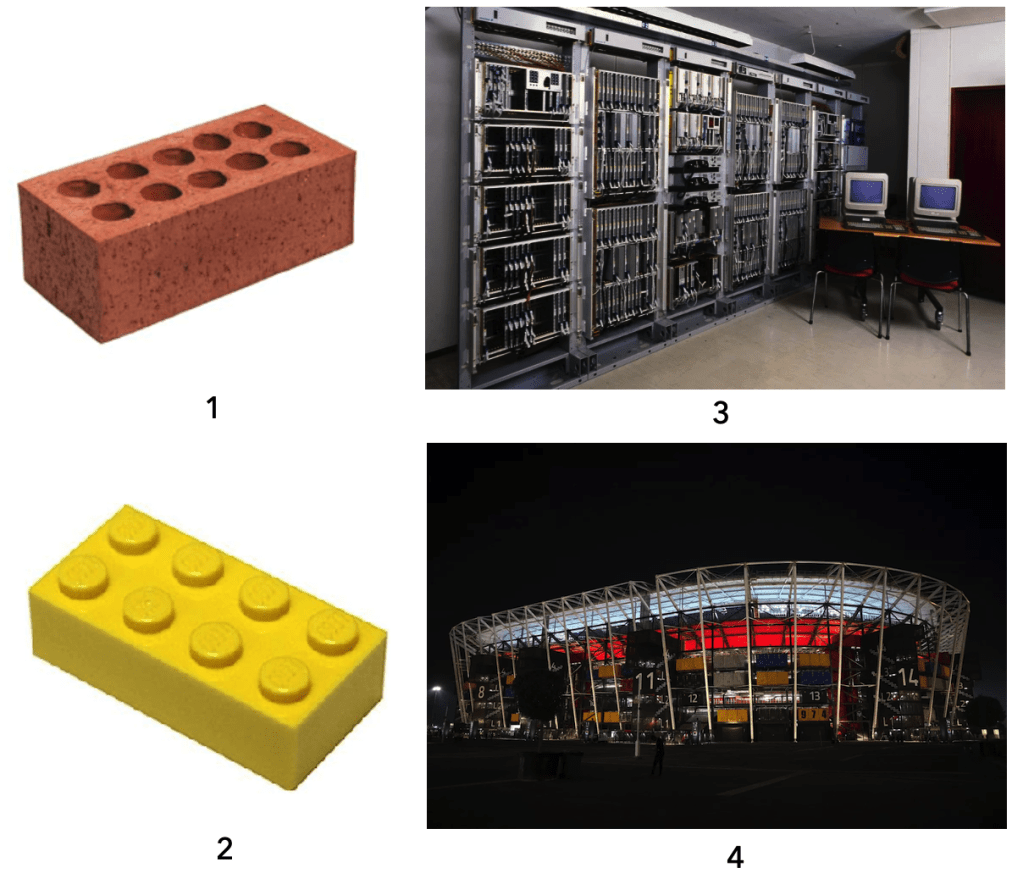
Which ones of the those four objects do you consider suitable to be called modules?
According to litterature references, modular thinking is a strategy of organizing complex products or processes in an efficient way. A modular system is composed of modules which are designed independently of each other, but that at the same time may work together as an integrated unit.
A product contains functional and physical elements. The physical elements are details, components or compositions which finally contribute to the function of the product. The physcial elements of a product are organized in various assembly blocks. If such a block is a collection of exchangeable components which execute similar functions, then the block is a called a module.
So, according to that reasoning, only 3) and 4) can be thought of as modular. Furthermore, the correct denomination for 1) and 2) is that they are components. I am sure that you all know what a brick and a Lego block are, so let us concentrate on examining 3) and 4) in bigger detail.
In 1979, I started my first job after having received my Masters degree in Electronics engineering from Chalmers. It was really interesting, a 1.5-year trainee course at the world-wide headquarters of the telecom company LM Ericsson in Stockholm, Sweden. Me and my three fellow colleagues visited many of Ericsson´s factories in Sweden and took many training courses in order to learn the theory behind the company’s products. It was then I first heard of modularity.
At that time, Ericsson was extremely busy changing the method of their central offices for telecommunications. Instead of the old electro-mechanical systems with a lot of valves and relays arranged in a big volume of hardware, the new systems based on the digital technology with computerized control were much smaller in size and were judged as more reliable than the old systems. The new system was called AXE and had been developed during the 1970’s at a development company called Ellemtel, joint owned by Ericsson and the Swedish Telecommunications administration, called Televerket.
When developing the AXE system, the engineers were using a novel approach, to organize both the hardware and software blocks of the final product according to the modular strategy. The result was astonishing, Ericsson grew from being one of the many telecom equipment producers in the world to lead the world market.
Then in 2022, when the FIFA World Cup was being played in Qatar, I was surprised by the way one of the stadiums was built. Yes, you guessed it right, using the modular thinking! The name of the stadium, 974, denotes the number of modules used to construct the stadium. According to a description by FIFA, Stadium 974 was constructed using standard certified shipping containers and modular steel elements, echoing the nearby port and the industrial history of the plot. Then, once the World Cup was over, the whole stadium was disassembled to be set up somewhere else for another game.
See also references 1,2, and 3 below about modularity.
In my blog post next month, I hope to able to show you some more examples of other objects that also are using the modular approach.
That’s what I learned in school today!
Ref.:
1: Min syn på modulariseringstänkande i PU-processen
2: AXE – a multi-dimensional system
3: Stadium 974
 What did you learn in School today?