2016-01-14 (Thursday)

Today, I learned that:

There is something new in the world of chemistry, and although I am not very fond of chemistry, this is really thrilling. IUPAC (The International Union of Pure and Applied Chemistry), announced that four new elements of the periodic table (elements 113, 115, 117, and 118) have been discovered and approved. These elements complete the 7th row of the periodic table of the elements, and the discoverers from Japan, Russia, and the USA will now be invited to suggest permanent names and symbols.
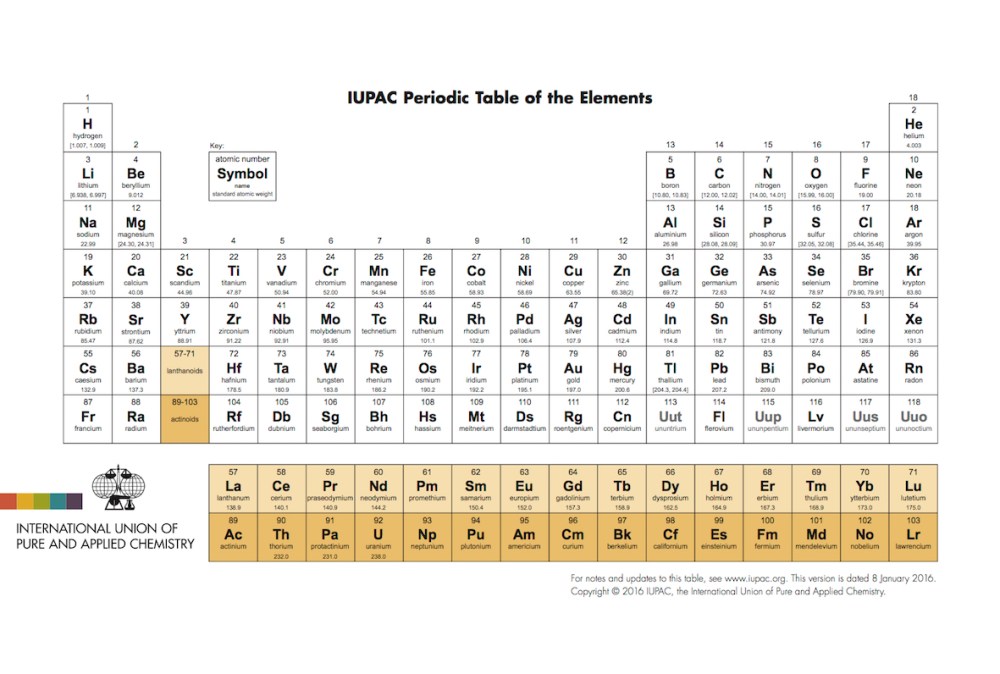
IUPAC_Periodic_Table-8Jan16

The current Periodic Table of the Elements, Copyright © 2016 IUPAC, the International Union of Pure and Applied Chemistry

Also, in the same podcast, The Naked Scientists, where these new elements were discussed, they talked about how the physicists Max von Laue and James Franck, who had won the Nobel Prize in 1914 and 1925, respectively, were able to save their golden medals from falling into Nazi hands during World War II. Their colleague George de Hevesy hid their medals in a bottle in a lab at the Niels Bohr Institute and dissolved them in aqua regia, a concentrated nitrogen hydrochloric acid (‘kungsvatten’ in Swedish). After the war, the gold solution was still there, and then it was transformed back into solid gold and recast to medals by the Nobel authorities in Stockholm. Finally, the scientists received their Nobel medals back.

… That’s what I learned in school!

Refs.:

1: 04:33 – Four new elements discovered

2: Discovery and Assignment of Elements with Atomic Numbers 113, 115, 117 and 118

3: Aqua regia

+: What did you learn in school today ?

2016-01-13 (Onsdag)

Idag har jag åter lärt mig, att:

Vad vi har det bra, om man jämför med alla skitjobb som det finns runt om i världen! Men frågan är om det finns något mycket värre än vad Sveriges Radio berättade om igår i Studio Ett.

Det handlar om arbetare som rensar kloakerna i den indiska staden Ahmedabad. Utan skyddsutrustning dyker de ned i förorenat vatten, fyllt av skräp, avföring, etc.

Lyssna och förundras över arbetsvillkoren:

http://sverigesradio.se/sida/artikel.aspx?programid=1637&artikel=6321283

… Slut för idag, tack för idag!

(This post is entirely in Swedish, with a link to a program by Radio Sweden, in Swedish, which deals with the horrendous job conditions for the workers who clean the sewage pipes in the Indian city of Ahmedabad.)

Ref.:

+: https://www.youtube.com/watch?v=VucczIg98Gw

2016-01-12 (Tuesday)

Today, I learned that:

The common expression “gigabyte” so often used today when talking about a quantity of data is not always a gigabyte, here is the story:

Some time ago, I discovered that there was a new type of USB flash drive (‘pen drive’) in the market, the handy little memory device that lets one move chunks of data from one computer to another. This particular device would be specially suited for transferring data from desktop/laptop computer to a smartphone, and vice-versa. The reason for this is that the drive has two different ports, one with a regular USB-A male connector and the other with a micro-USB AB receptacle. I decided to buy the smallest one, specified at 16 Gbytes of memory.

When it arrived, before even saving any file onto the drive, I investigated if it really could hold 16 Gbytes as specified. Well, it could not! My Mac computer showed that the maximum capacity when using a file format called Extended File Allocation Table (exFAT), which would permit compatibility between OS X, Windows and Android, was 15 549 300 736 bytes, also informed as 15,55 GB by the Mac. In Windows, it was even less, 14,4 GB. So how come this difference, more than 1 GB?

The reason is that Apple uses the decimal definition of gigabyte, where 1 gigabyte (GB) = 1000 x 1000 x 1000 bytes = 1 000 000 000 bytes, and Microsoft uses the binary definition, that states that 1 gigabyte (or more correctly 1 gibibyte – GiB) = 1024 x 1024 x 1024 = 1 073 741 824 bytes.

The recommended international standard, in unison with the International System of Units (SI), is to use only the prefixes kilo, mega, giga, etc. as multiples of 1000, and kibi, mebi, gibi, etc. as multiples of 1024.

The word gibi is also used in Brazil to denote a comics magazine, in Swedish called ‘serietidning’.

… That’s what I learned in school!

Refs.:

1: USB flash drive

2: USB

3: ExFAT

4: Gigabyte

5: Gibi

+: What did you learn in school today ?

2016-01-11 (Monday)

Today, I learned that:

The 21 regions and county councils (“landsting”) in Sweden are currently procuring at least 6 small aircraft for ambulance transport, in an international tender with March 1, 2016, as deadline. One of the requirements deals with the appearance of the aircraft:

“Requirement 2.0.16
GENERAL REQUIREMENTS ON AIRCRAFT

The Aircraft shall be delivered with yellow paint (RAL 1016) with green rectangles (Battenburg markings, RAL 6026) on each side of the aircraft body, registration marks according to EASA and Swedish Transport Agency requirements, and furthermore possess the minimum marking containing the text “Ambulans”, the symbol ‘Star of Life’ and the company logotype.

Reference: SOSFS 2009:10.”

So what are RAL and Battenburg markings?

RAL is a colour space system introduced in Germany in 1927 in order to certify colour nuances and thus guarantee that a certain colour would always look the same. Originally there were only 40 colours, but today there are hundreds in the updated versions. It is widely used in Europe to specify the colour of an industrial product.

Battenburg (originally Battenberg) patterns consist of two contrasting colours side by side, e.g. as in a chess board. The name is derived from the cake that was baked for the marriage in 1884 by Prince Louis of Battenberg to Princess Victoria. The original cake was formed by alternate pink and yellow sponge cakes with a marzipan icing.

… That’s what I learned in school!

Refs.:

1: Complete procurement documentation

2: SOSFS 2009:10 Ambulanssjukvård m.m.

3: RAL colour standard

4: RAL-colours make the difference

5: Battenberg cake

6: Battenburg markings

+: What did you learn in school today ?

2016-01-10 (Sunday)

Today, I learned that:

The purpose of international standards is to ensure quality, safety and efficiency in international matters involving products, services and systems. They are normally issued by the International Organization for Standardization (ISO), based in Geneva, Switzerland.

ISO 8601:2004 is the current standard for writing calendar dates, also adopted by all countries in EU. It defines that dates shall be written as in this post’s title, “YYYY-MM-DD (2016-01-10)”. Although there are only some well defined alternatives to this format, one the few countries that uses this standard notation coherently is Sweden, but there are also Swedes that ‘prefer’ to use other formats. Some examples of a different notation in other countries are:

USA 1/10/2016
Brazil 10/01/2016

… That’s what I learned in school!

Refs.:

1: ISO

2: A summary of the international standard date and time notation

3: Date format by country

+: What did you learn in school today ?