272’2023 (2023-09-29) – Friday

Today, I learned about:

In my previous post, I talked about the small differences in sport between success and failure. Here are two more such events, both of them involving Swedish athletes:

Swimming men 400 m individual medley in Summer Olympic Games 1972

An earlier such fact happened in the Summer Olympics Games in Munich on August 30, 1972. In the final of the 400 m individual medley for men, the two first swimmers were registered for the same time, 4 min 31,98 s. So far using hundredths of a second had been sufficient to decide a winner, but in this case the organizers had to go further down, to the thousandths of a second, and then it was discovered that the Swede Gunnar Larsson had the time of 4 min 31,981 s, while his major opponent, the American swimmer Tim McKee was recorded for 4 min 31,983 s, 2 thousandths of a second slower, or converted into distance 3 mm. Of course there were many people who wanted the goal medal to be shared between the two swimmers, but the decision was to keep them apart. I remember very well this event, I was at home watching the event live on TV and how everyone was apprehensive about the outcome.

Thousandth second timing was also used at the 1973 World Championships, but this would not be allowed again, as it was shown that this was less than the thickness of one coat of paint on the wall, and minute differences in the lanes could affect this result. All future international swimming races after 1973 would be decided only to the 1/100th of a second, and if swimmers were tied at that margin, they were declared tied. However, that decision did not have any retroactive result, so Gunnar Larsson continued as a sole winner in 1972. But Tim McKee could at least console himself that both he and Gunnar were registered as having broken the old olympic record.

Since then, there have been three different olympic events where the two first swimmers have shared the gold medal, all in freestyle swimming, in 1984, 2000, and 2016. Will there be anext one in 2032?

See also reference #1 below.
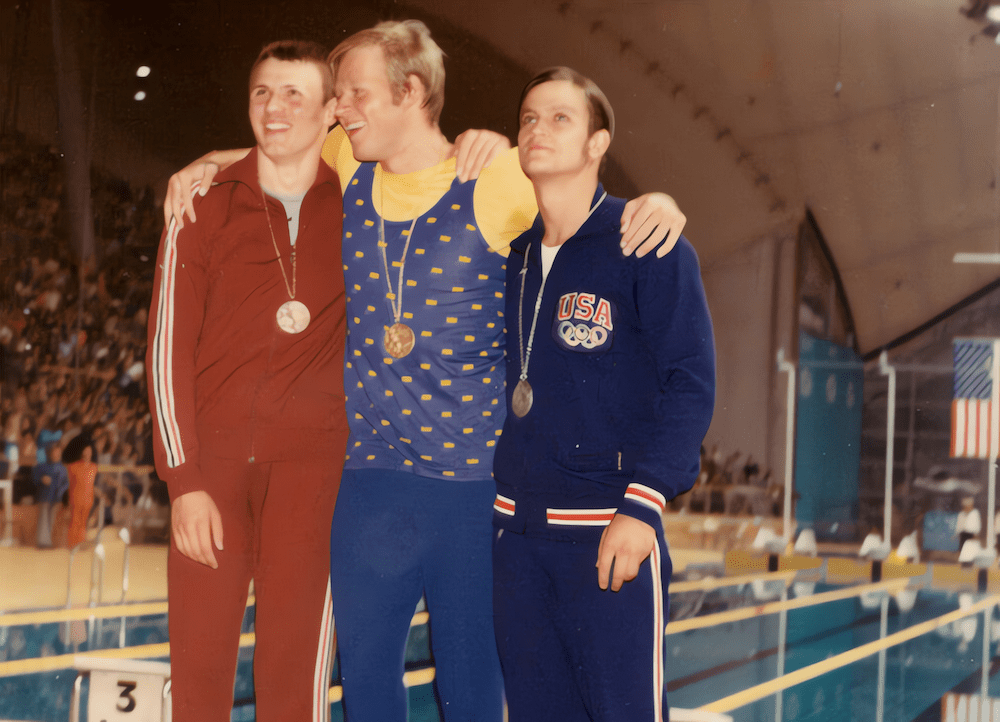
The winners podium after the 400 m individual medley, the winner Gunnar Larsson accompanied by the silver medalist Tim McKee (to the right) and bronze medalist Andras Hargitay, Hungary (to the left).

Triathlon women individual event in Summer Olympic Games 2012

Another similar event happened in the Summer Olympics Games in London on August 4, 2012. It was hosted in Hyde Park, and the first three athletes were all within 2 seconds at the finish line. Of those, the two first competitors ended up with the same time, 1 h 59 min 48 s. But the Swiss athlete Nicola Spirig was judged as being the winner in a photo finish, with the same time as the Swede Lisa Nordén. The Swedish Olympic Committee appealed against the result in the Court of Arbitration for Sport (CAS), but it turned down the appeal.

See also reference #2 below.
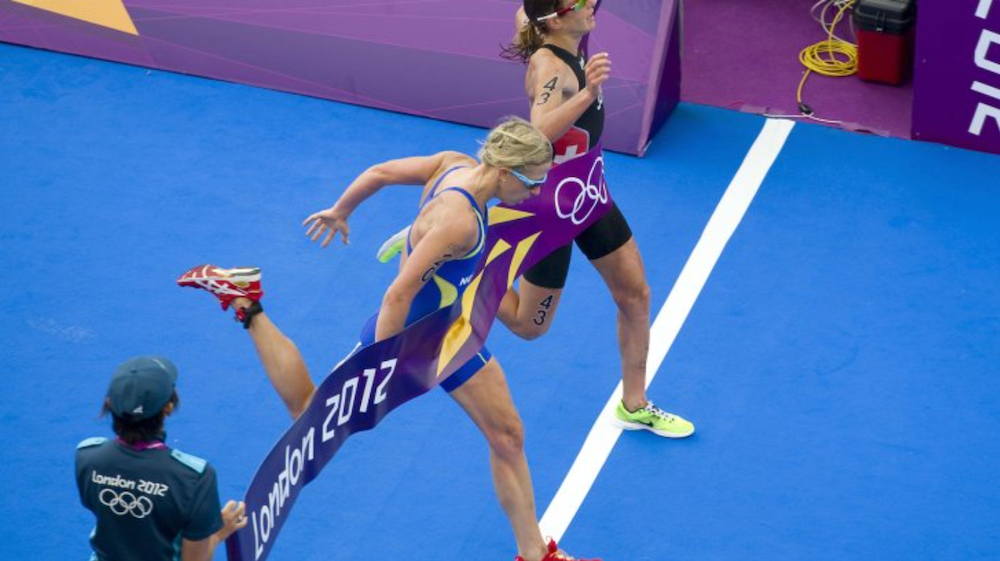
The thrilling photo finish with Lisa Nordén (foremost) and Nicola Spirig side by side. Photo by Imago.

Winter sports in Brazil

You may remember that a little over a year ago, in my post 240’2022 (2022-08-28) , I wrote about the two Brazilian winter sports organizations, CBDG (ice) and CBDN (snow), and presented the Arena Ice. Last week, I had the opportunity to visit the Arena Ice again, this time together with my fellow associates of Swedcham, the Swedish-Brazilian Chamber of Commerce in São Paulo, and practice some curling under the supervision of one of the curling instructors at CBDG, Fabrício Dias Paes. We all had very much fun in trying to master the 20 kg heavy curling stone and guide it to its goal. Here you can see some photos taken by Anders Pettersson and myself:
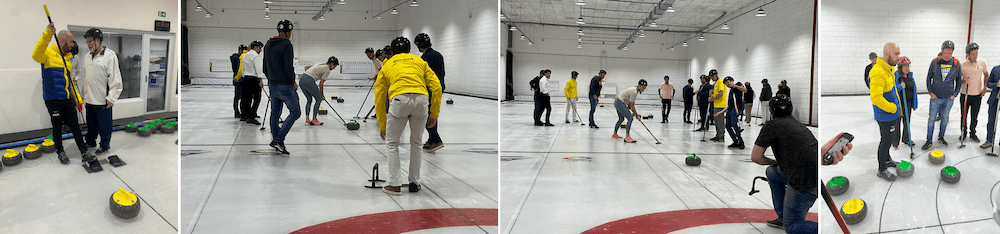
Curling practice in Arena Ice on 264’2023 (2023-09-21)

Then on the following weekend, from my home in São Carlos, I could watch two very different sports events happening at the same time in the region of Morumbi in São Paulo, to the left the final in the Brazilian Championship in Icehockey 3×3, held at the rink in Arena Ice, and to the right the final in the Brazilian Football Cup, occurring only 4 kilometers from Arena Ice. Unfortunately, the home team Big Hockey Brazil lost the final 3-4 to the Falcons from Bragança Paulista, but São Paulo FC compensated that by securing the Brazilian Football Cup with a draw 1-1 against the Rio team Flamengo, after having won the first game in Rio de Janeiro one week before.
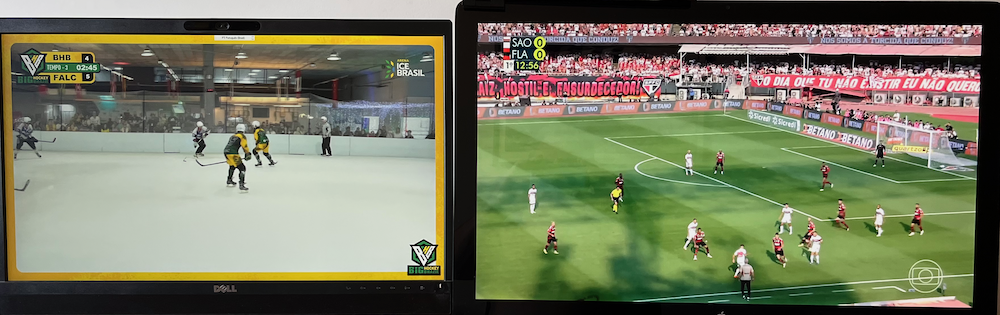
Two totally different sports happening at the same time only 4 km apart on 267’2023 (2023-09-24).

By the way, during this weekend, there is also a Brazilian Championship in Curling for Mixed couples being played in Arena Ice. If you want to accompany it live, you can do so on this link: https://youtube.com/live/laEfuz7FYMU

Finally, today’s header photo was taken in the Argentine capital Buenos Aires by my daughter Karina on 250’2023 (2023-09-07). This metallic rose opens its petals during the day and is called Floralis Genérica. See also reference # 3 below.

That’s what I learned in school today!

Ref.:

1: Winning margin of two thousandths of a second in 1972

2: Photo finish in 2012

3: Floralis Genérica

*: What did you learn in school today?

2019-04-01 (April Fool’s Day!)

Today, I learned that:

Very recently, I received two pieces of sport news from Sweden which really made me both laugh and admire the initiative force of Swedish female athletes of all ages.

The first one is about curling. One week ago, Switzerland beat Sweden in the final of the women’s world championships, held in Silkeborg, Denmark, situated close to what was once considered to be highest point in Denmark. As you can see from this slogan, Danish mountain climbers have a blast there:

By the way, the highest peak here, called Himmelbjerget (which means the mountain of heaven) reaches impressive 147 m! See also reference #1 below.

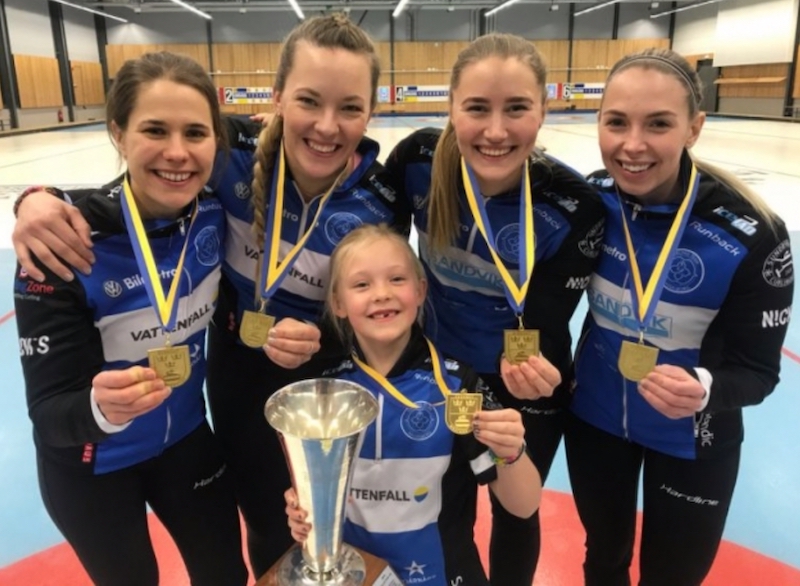
But getting back to curling, one of the members of the Swedish team is called Agnes Knochenhauer. She won a gold medal in the Winter Olympics in PyeongChang in 2018, and after that, she and her team mates have won the European Championships and twice been runner up at the World Championships. In January this year, the same team from Sundbybergs CK also played in the Swedish Championships, held in Jönköping. Agnes let her 7-year old daughter, Tilda, visit the games together with her mother. Tilda has already started her own career and when the team skip, Anna Hasselborg, got sick, Tilda jumped in and replaced Anna, not as a skip, but as one of the other players. The result was beyond expectation, the team won the championships and little Tilda can now put Swedish adult champion on her business card! See also reference #2 below.

The Swedish champions 2019, from left to right: Anna Hasselborg, Agnes Knochenhauer, Tilda Knochenbahuer, Sara McManaus, and Sofia Mabergs. Photo taken on 2019-01-06 by Svenska Curlingförbundet.

And yesterday happened another interesting fact. During the last day of the Swedish Championships in biathlon, which had relay races on the program, another Olympic champion from PyeongChang, Hanna Öberg, also got sick and could not participate together with her teams mates in the women’s team event. That meant that her club, Piteå SSK, had to withdraw from the competition. But one of the two other team mates, Anna Magnusson, won a bronze medal nevertheless! She participated in the men’s (!) relay race with two male colleagues. See also reference #3 below.

The Swedish female biathlon athlete Anna Magnusson, now historic Swedish male champion, in a photo taken in Oberhof on 2018-01-04 by Christian Bier

That’s what I learned in school !

Refs.:

1: Silkeborg

2: 7-åriga Tilda ersatte OS-ettan och vann SM-guld

3: Anna Magnusson tog stafettmedalj – för herrar

*: What did you learn in school today ?

2018-05-24 (Thursday)

Today, I learned that:

Last Sunday, the Swedish male icehockey team won the World Championships again. You may remember from my post of 2017-05-21 how they won it last year as well. And also this year, the title was won after the final penalty shoot out. But this year, their campaign in the whole tournament was almost impeccable, all games won and only one point lost. The final was held in Copenhagen, Denmark, almost a home game then.

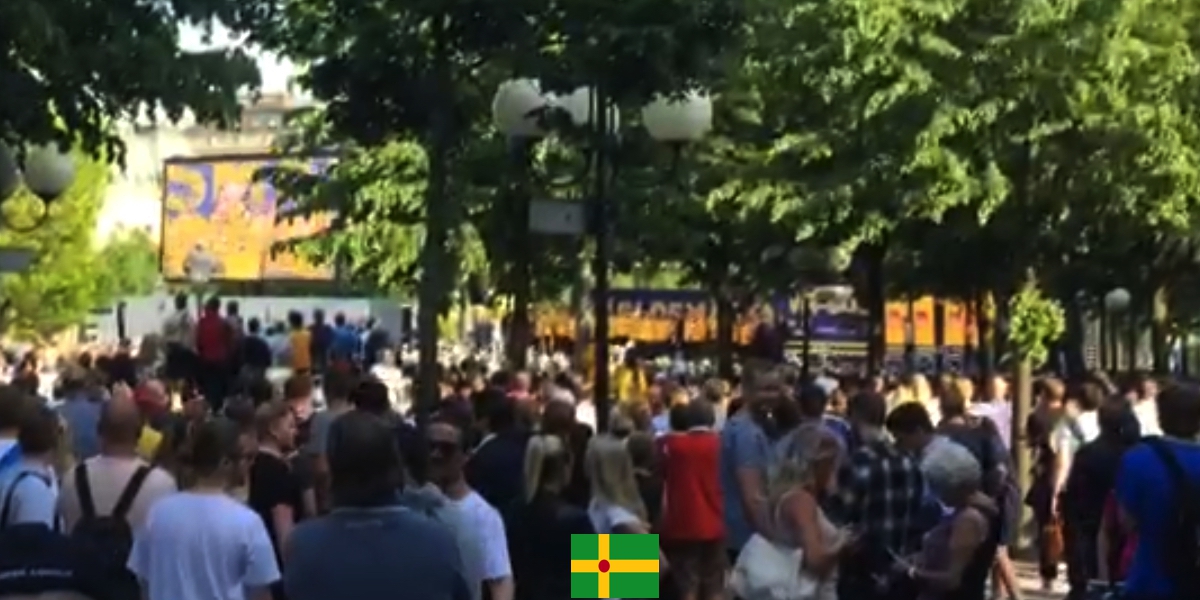
So what could be better than to publish a photo of how the team was received on 2018-05-21 at the park Kungsträdgården in central Stockholm. My Brazilian friend who lives there was also enjoying himself in the sunshine and sent me some nice photos and video clips, muito obrigado! This photo shows the moment when John Klingberg raises the trophy to the enthusiastic crowd’s cheers.

Kungsan

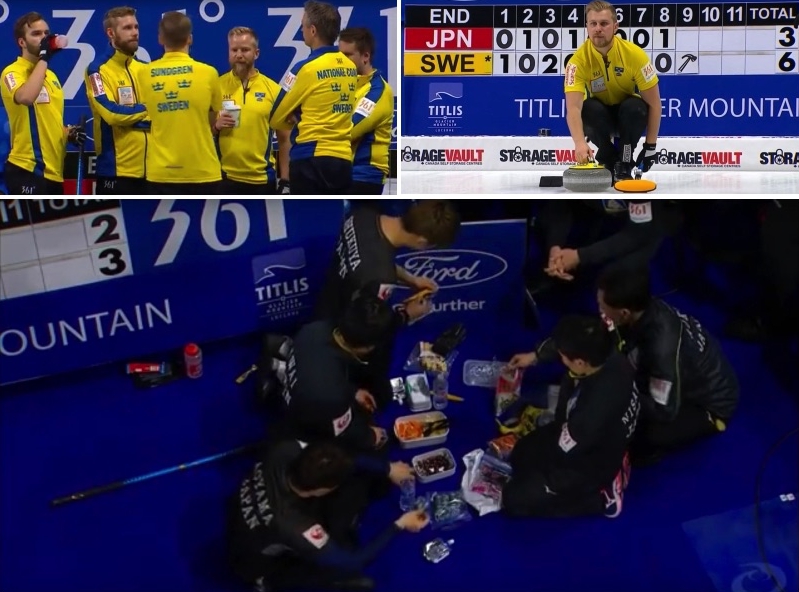
In April, I invested quite some time to accompany all the details of the world championship in curling for male teams, which happened in Las Vegas, NV, USA, as I already anticipated in my post of 2018-03-24. Have a look at the photos below. Besides the different feeding habits of the Swedish and Japanese teams during the mid-game intermission, it is also interesting to note that although the competition is hosted by one of the densest neon and electronic cities in the world, the scoreboards are still manual, mechanical ones with the scores being recorded by magnetic tabs. (In the women’s tournament in March, all scoreboards were electronic.)

LV2018

Three photos taken during the round robin game between Sweden and Japan on 2018-04-06. It is interesting to note how the Japanese cannot forget their habit of bringing the traditional obento, i.e. a lunch box full with culinary delicacies. All photos are screenshoots from the video coverage supplied by the World Curling Federation. See also reference #1 below.

That’s what I learned in school !

Refs.:

1: Japan v Sweden – Round-robin – 361º World Men’s Curling Championship 2018

*: What did you learn in school today ?

2018-03-24 (Saturday)

Today, I learned that:

Most people around the world do not have the slightest idea what curling is. Well, it is a sport with centuries of traditions from the ices in Scotland which was first introduced to the Winter Olympic Games already in 1924 for a one-time appearance. It then reappeared there permanently in 1998 and now it is one of the most exciting events of the whole games, often called ‘Chess on Ice’, due to the similarities in needing to predict moves well ahead.

Curling is played on an ice sheet with the approximate dimensions of 45 x 5 m. The traditional way is to play the game in teams of four players (in separate male and female disciplines) and recently also in mixed doubles. In the four-member games, each team player has two 20 kg granite stones that s/he tries to place close to the target. Whilst one of the players throws the stone, two other members use their brooms to sweep the ice to ease the stone in getting to its target, under the guidance of the captain (called skip). More details about this fascinating sport can be found in reference # 1 below, and in reference # 2 is a video showing how the curling stones are made.

The yearly women’s world curling championships are taking place this week in North Bay, ON, Canada, another of the leading curling countries. The thirteen participating national teams played each other once in a round robin format. The two best teams in the number of wins, Canada and Sweden, were directly qualified into the semifinals and the third to sixth teams played two games this morning to qualify as the remaining two semifinalists. In one game, Russia beat Czechia, and in the second game, between USA and South Korea, the game was tied at 3-3 after 8 periods (called ends). Then in the ninth end (out of a maximum of ten ends, if no extra end is necessary), something very rare happened, and this was only the third time at all in the history of these world championships.

Since each team throws 8 stones in one end, the maximum theoretical score for one team per end is consequently also 8. That has never happened, but in 1999 Sweden beat Denmark by scoring 7 points in one end, and in 2002 Norway repeated that feat against South Korea (yes, they were involved already then).

In this morning’s game, the Korean players made two fatal mistakes. In throwing stone 11, their vice-skip Kim KyeongAe committed a so-called hogline violation, meaning that she did not release the stone in time, and thus that throw was declared as void. Then in stone 15, the Korean skip Kim EunJung (yes all four ordinary players and the substitute are called Kim, and two of the five players are sisters) throw the stone too hard. In reference # 3 is the official shot-by-shot report from the game and in reference # 4 is a link to a video recording from the game, if you are interested in viewing this rare fact. And in one week’s time, Las Vegas, NV, USA will be the host for the men’s curling world championships. Las Vegas rocks!

And I also learned that in a recent male tournament, something probably even more rare happened, that two stones with opposing colours were both at the exact same distance from the center, so that neither team could win any point. You can find that video clip in reference # 5 below.

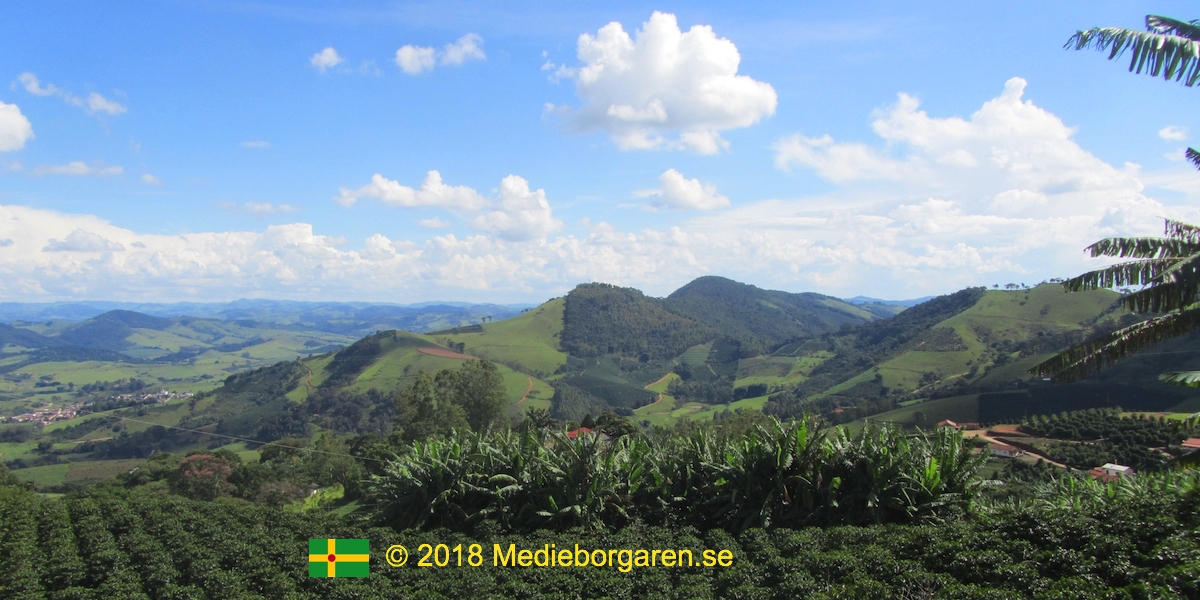
The photo below was taken in the Southern part of the Brazilian State of Minas Gerais. Travelling on its highways you may find many breathtaking views and this was surely one of them. It was taken close to the city of Ipuiuna on 2018-03-04 from a view point with the adequate name of Pedra do Mirante.

Pedra do Mirante

Photo taken on 2018-03-04 from Pedra do Mirante, close to Ipuiuna, Minas Gerais, Brazil.

That’s what I learned in school !

Refs.:

1: Curling

2: How it’s made – Curling stones

3: Shot by Shot KOR-USA

4: Korea vs United States – Qualification game (3v6) – Ford World Women’s Curling Championships 2018

5: Most bizarre curling play of the year results in tie end

*: What did you learn in school today ?