11’2024 (2024-01-11) – Gala lights

Today, I learned about:

As I have mentioned in two earlier posts in 2022, 16’2022 (2022-01-16) and 58’2022 (2022-02-27), this time of the year in the Northern hemisphere can show the interesting Aurora borealis (Northern lights) and six months from now the time will come for the Southern hemisphere with its Aurora australis (Southern lights). But there is also a different phenomenon that can be present and seen if we are lucky.

Yesterday, I received a message from my good old friend Dina, native from Kazakhstan, who nowadays lives in Ireland. She had gotten a photo from a friend of hers in Uralsk, her home town. You can see the picture in today’s header. In Russian this phenomenon is called the equivalent of Gala lights, but when searching for that term on Google, I found nothing. Dina discovered that the English denomination is Light pillar, and in contrast to Northern and Southern lights being electric impulses, the Light pillar is more of an optical illusion, similar to a halo or a rainbow, where water drops high up in the sky refract the sun light and create this marvellous sensation. But this can only happen when the sun is very low on the horizon, rising or setting, and in temperature below -20 degrees Celsius. More of this can be found in reference #1 below.

Addendum on 13’2024 (2024-01-13)

Only two days after I published the post above, I learned of another interesting natural phenomeon that only can occur during the winter.

This time it is an earthbound matter. In the vicinity of Gothenburg, Sweden, a woman named Emelie Mellberg decided to take a walk on sunny winters day. When she came to the lake Kåsjön, there was something absolutely marvellous that caught her eyes. On the frozen ice surface were thousands of ice crystals forming flowers, the reason why this phenomenon is called ice roses. It happens when the droplets reach the surface from underneath. Water vapor freezes on the drops and starts to form flowerlike figures. The conditions for this to occur depend on the air temperature and humidity. There is a need for clear sky, a light wind and cold weather. See the following photo and the video clip in reference #2. My warmhearted thanks to my friend Cecilia for appointing this to me!
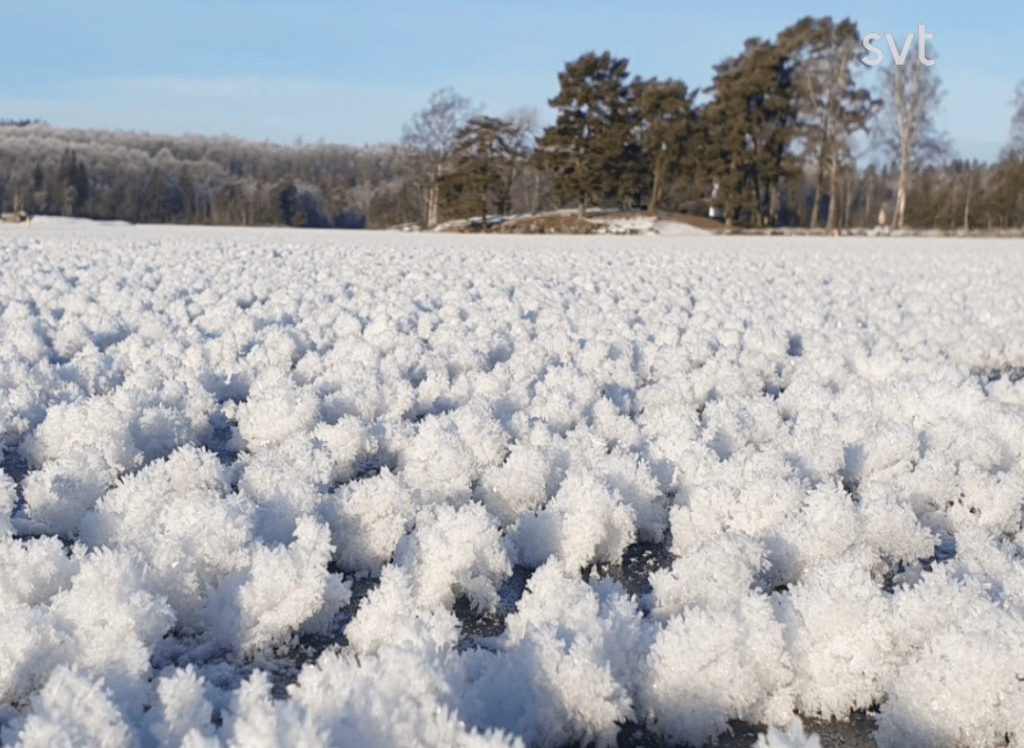
Ice roses on Kåsjön, Gothenburg. Photo by Emelie Mellberg and published by SvT.

That’s what I learned in school today!

Ref.:

1: Light pillar

2: Ice roses
*: What did you learn in school today?

58’2022 (2022-02-27) – More Aurora

Today, I learned about:

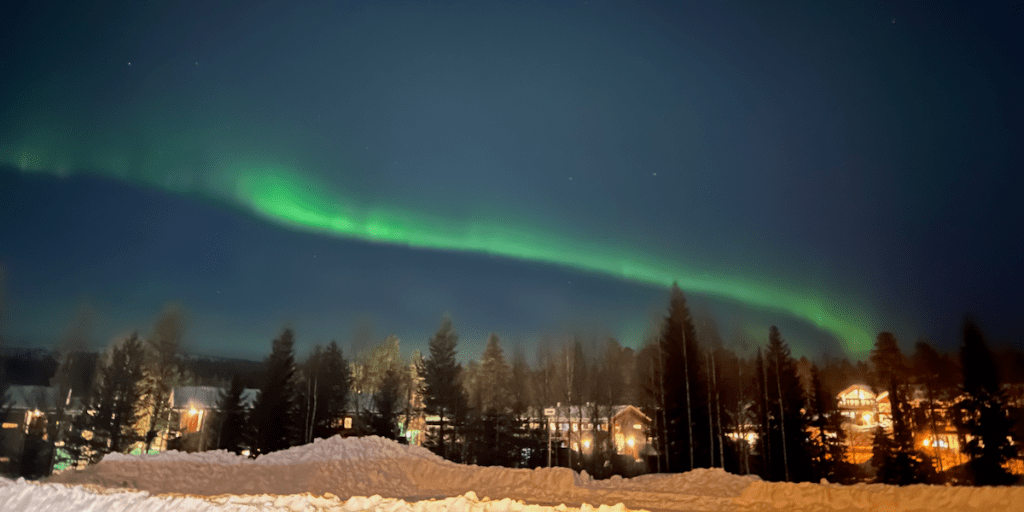
In my post of 16’2022 (2022-01-16) I talked about the Northern lights that had been seen over most parts of Sweden. Approximately 28 days later, when the Sun’s corona hole once more was directed towards Earth, it was more restricted to Northern latitudes. The photo below was taken on 41’2022 (2022-02-10) outside of Sälen, Dalarna, Sweden, and I hope you agree with me that it is marvellous to see such wonders of Nature. The further north you go, the bigger the chance of experiencing it.

This amazing picture of aurora borealis was taken outside of Sälen, Dalarna, Sweden on Thursday 41’2022 (2022-02-10).

That’s what I learned in school today!

Ref.:

*: What did you learn in school today ?

16’2022 (2022-01-16) – Aurora

Today, I learned about:

This time of the year in the Northern hemisphere, there can appear an interesting phenomenon in the sky. It is called aurora borealis (Northern lights) and the further north you go, the bigger the chance of experiencing it. When it is winter season in the Southern hemisphere, six months from now, there is also the same phenomenon there, called aurora australis (Southern lights).

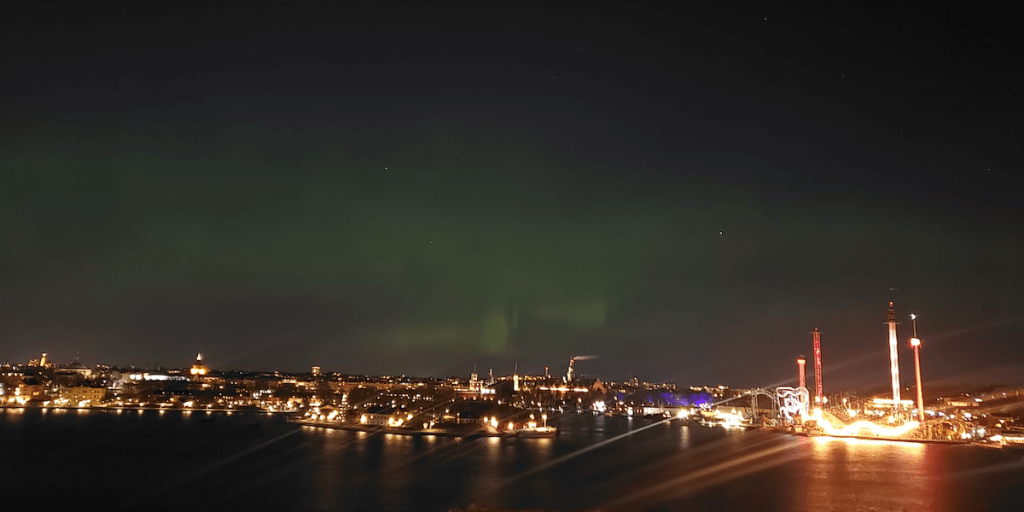
When I lived in Sweden during the 1970s and 1980s, I was lucky to have that view twice. The first was in September 1973 in Ystad on the extreme Southern coast and the second time was in Stockholm in mid-winter in 1982. And now I am informed that most parts of Sweden have had the chance to see “norrsken”, the Swedish denomination, during this weekend. The following photo was shot by my friend Arthur in Stockholm shortly after midnight on Saturday 15’2022 (2022-01-15). It was taken from Södermalm towards Strandvägen and Djurgården. Thank you, Arthur, for this Swedish (de)light!

It was one of those rare occasions when also the southern parts of Sweden could see the phenomenon of aurora borealis. Arthur Ribas took this photo from Södermalm in Stockholm, looking out over Djurgården, shortly after midnight on Saturday 22’2022 (2022-01-15).

If you want to discover what Northern lights really are, take a look in reference #1 below.

Another thing that I heard of these days is that in the USA, on 7’2022 (2022-01-07), man for the first time received a heart from a genetically altered pig. You can read more about it reference #2 below.

And today, in the morning radio news show Godmorgon, världen on Radio Sweden was discussed more about that heart transplant, if the patient’s body will accept it and not reject it, which ethical aspects we can apply to this case, if it will be possible to start using transplanted organs from animals, etc. If you understand Swedish, I urge you to listen to the interesting conversation in reference #3.

That’s what I learned in school today!

Ref.:

1: Aurora

2: In a First, Man Receives a Heart From a Genetically Altered Pig

3: Så kan vi påverkas när djurens organ blir våra reservdelar

*: What did you learn in school today ?