2016-07-04 (Monday)
Today, I learned that:
If you are in the US, then you can enjoy an extra day off work and celebrate the nation’s independence day, congratulations!
And thanks to the internet you can also listen to a Swedish radio programme, where Gloria Ray Karlmark counts her life story, including fighting for racial emancipation in Little Rock, Arkansas, and being the first coloured female student at MIT. But you need to know Swedish, and if you do, the link can be found in reference #1 below.
And when it is time for the fireworks tonight, think about what is happening at that very moment even further out in the sky, on a distance 48 light-minutes away. A Nasa probe named Juno penetrates the Jupiter atmosphere, searching for clues to the composition of this gigantic planet, the biggest one in our solar system. For more information, see reference #2 below.
But do you know why the probe is called Juno? It all started back in ancient Rome. Their god of gods was Jupiter, married to Juno. But Jupiter also had women on the side, the four most prominent being Io, Europa, Ganimedes and Calisto. In order to hide his extra-marital affairs from his wife, Jupiter surrounded himself by a cloud. But the jealous Juno had a sight which could penetrate that cloud. So now, Juno will once again penetrate the clouds of Jupiter and report her findings to Mother Earth.
In the meantime, I suggest you appreciate the following image. Further information can be found in reference #3 below.
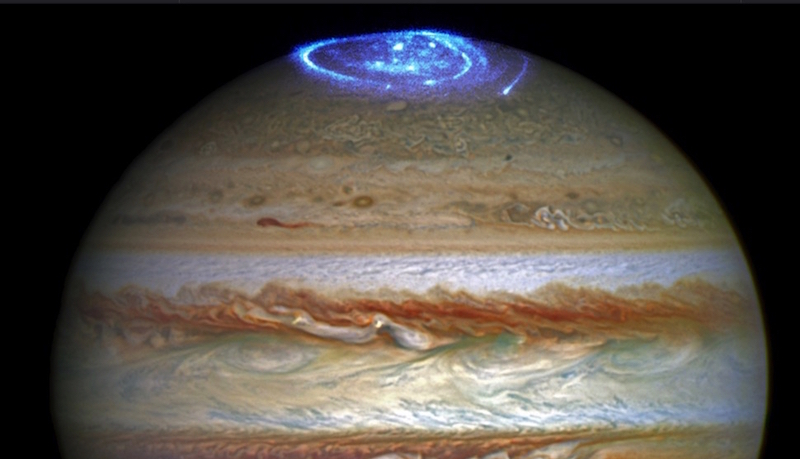
An image showing what the Hubble telescope found when directing UV rays towards Jupiter. It shows a permanent aurora, a result of the combination of solar winds and charged particles from the planet’s biggest moon, Io. Image by NASA, ESA, and J. Nichols (University of Leicester)
… That’s what I learned in school !
Refs.:
2: Juno by NASA
 What did you learn in School today?