2016-02-23 (Tuesday)
Sorry, no post today either. Hopefully, tomorrow I will be able to return with another interesting subject.
Sorry, no post today either. Hopefully, tomorrow I will be able to return with another interesting subject.
Due to an accident, unfortunately today there will be no post. I will get back as soon as I can.
Today, I learned once more that:
One of the most abstract things in our world is also something that we rely on the most. I am thinking about the so-called fourth dimension, time. Due to the earth’s rotation around its own axis, the world has been divided into 24 time zones, with the meridian that crosses the Greenwich observatory in England used as a starting point for the division, and thus establishing Greenwich Mean Time (GMT), nowadays mostly named Coordinated Universal Time (UTC).
Due to its subcontinental size, Brazil has four different time zones, which are related to the official Brazilian time in the Federal capital of Brasília. The following times apply as standard times:
The reason I am mentioning this today is that yesterday at midnight in Brasília, some of the states mentioned above, namely the Federal District and the 10 Southernmost states (Rio Grande do Sul, Santa Catarina, Paraná, Mato Grosso do Sul, São Paulo, Rio de Janeiro, Espírito Santo, Minas Gerais, Goiás, and Mato Grosso) ended the period of Daylight Savings Time (DST), also called Summer Time, that had been valid since October 18, 2015. The population in those areas account for 64 % of the total Brazilian population.
DST was used in Brazil for the first time in 1931, but from then on there was no consistency in when it was applied. It was only in 1985 that DST was instituted and followed on a regular, annual base, normally between the third Sunday of October and the third Sunday of February the subsequent year. However, Carnival and general elections have influenced on different start and end dates on some occasions.
One interesting observation that can be made is that the change always happens around midnight Brasília time, which creates a big confusion about which day it is at a given time. To me, the European rule of making the change at 02:00 / 03:00 seems much more logical.
However, there are people that oppose to the use of DST. As an example, there are currently three different propositions in the Brazilian Congress that want to forbid the use of DST. One of those propositions was written by congress man Valdir Colatto from Santa Catarina. Here are his arguments:
Solution to Riddle # 1 (Two blind men), posted on 2016-02-19
When the socks are sold in the store, they are also grouped together in pairs. Thus, it is easy to grab one pair, separate the socks and place one each in each of the two men’s bags. Continue doing so, and eventually you will have two blue socks, two red socks, two pink socks, two green socks, and two orange socks in each bag.
I have already told this riddle to many people, but only one person could ever solve it, and it took only 15 seconds! This is a tribute to my good old friend, the chemist John Snyder, one of the most intelligent people I know!
The riddle was first proposed by Kim Nasmyth, Professor of Biochemistry at the University of Oxford, to explain how chromosomes divide in cell division, see reference # 3 below.
Riddle # 2 (The pill roulette)
You suffer from a temporary disease, which you have to treat by taking one pill every day during seven days. So the pharmacist took your order and gave you the pills. You are just about to take the first pill, when you receive a telephone call from the pharmacy.
You are informed, that the attendent mistakingly gave you eight pills, the seven you need and also an eighth one, that has the same appearance as the other. But it is poisonous and furthermore it weighs a little bit more than each of the other seven, undetectable by assessing it in your hand, but sufficient to be determined by a precision scale.
Luckily, you are in a laboratory which has such a scale, an old analogue weighing scale with two pans for high precision weight measurement. The problem is that you will only be able to perform two measurements, after which the scales will not work any more.
Here is a drawing of the scales you can use:
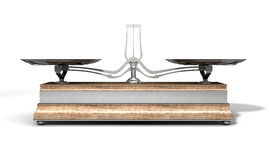
A two-pan balance scale to be used in riddle # 2
So how do you solve this riddle, to identify and discard the poisonous pill, with only two comparative measurements? A solution to this riddle will be published next Saturday, 2016-02-27. The first person that comes across the correct solution and sends it to medieborgaren@sjson.com will receive an honorary mention.
… That’s what I learned in school !
Refs.:
2: Horário de verão acaba à meia-noite deste sábado
Today, I learned that:
Scientists at the Optoelectronics Research Centre of the University of Southampton, on England’s Southern coast, have made a major step forward in the development of digital data storage that is capable of surviving for billions of years. Using nanostructured glass, they have developed the recording and retrieval processes of five dimensional (5D) digital data by femtosecond laser writing.
The storage allows unprecedented properties including 360 TB/disc data capacity, thermal stability up to 1000 °C and virtually unlimited lifetime at room temperature (13,8 billion years at 190 °C ) opening a new era of eternal data archiving. This very stable and safe form of portable memory, could be highly used to store massive quantities of information, such as those found in national archives, museums and libraries.
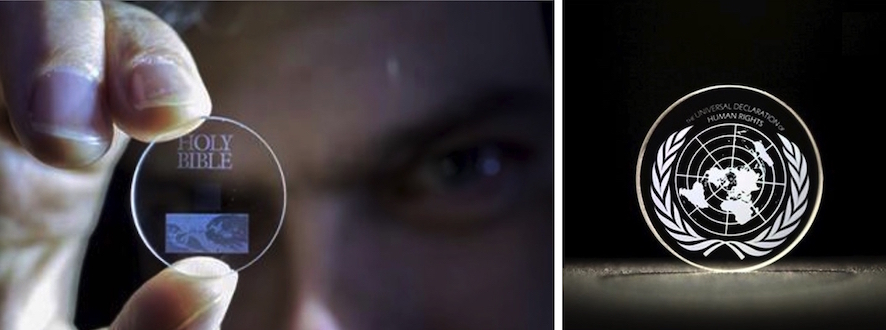
Two examples of eternal 5D storage, King James Bible and the Universal Declaration of Human Rights. Copyright and photos by the University of Southampton 2016
In 2013, they demonstrated a 300 kbyte digital copy of a text file recorded in 5D, and now other documents such as the Universal Declaration of Human Rights (UDHR), Newton’s Opticks, Magna Carta and Kings James Bible, have also been saved.
Further information about this amazing storage technology can be found in reference # 1, below.
That’s what I learned in school !
Refs.:
1: Eternal 5D data storage could record the history of humankind
Today, I learned that:
There are two blind men who go shopping, and what is the one thing that you most often have to go and buy when you go shopping when you’re a man? It’s usually socks because you put them into the wash and one of them disappears. And even though they are both blind it turns out that their wives like them to wear coloured socks and their wives like variety. So together, they go off and buy five pairs of socks each; a blue pair, a red pair, a pink pair, a green pair, and an orange pair. Now, the shop assistant finds this a somewhat eccentric purchase and gets slightly muddled and puts all ten pairs of socks into the same bag and they leave the shop, and one of them has got a bag with ten pairs of socks, the other has no socks.
Shortly before going their separate ways and going home and showing their socks proudly to their wives and saying, ‘Look what I’ve bought today,’ they realise that one of them has got all the socks. They say, my God, how can we sort out this problem so that each of us has one blue pair, one red pair, one pink pair, one green pair, and one orange pair? The question is the following: how do the two blind men achieve this goal without their wives helping them, without the socks being of different lengths, without the socks having any different texture or whatever? As far as the blind men are concerned they wouldn’t be able to tell the blue pair from the red pair. But how would they ensure that they could divide the socks up so that each of them would have two blue socks, two red socks, two pink socks, two green socks, and two orange socks ?
There is a very simple solution to the problem. I will give you time until Sunday, two whole days, to try and solve it.
Update 2016-02-21: A solution to this riddle can be found on Solution to riddle # 1 (Two blind men).
Refs.:
Today, I learned that:
Researchers at the Australian National University, with headquarters in the nation’s capital Canberra, are reporting about the results they have obtained from ten years of study of ground-nesting wasps, in order to find out how they manage to find their way home to the nest.
According to professor Jochen Zell, he and his rearch colleagues found that the wasps perform learning flights every days to ensure that they can always come home. He says about the wasps that “…their abilities make them smarter than anything humans know how to build.” This inspired the researchers to create equipment to mimic the wasps behaviour, and they now want to apply the acquired knowledge in the development of autonomous flying robots. More information can be found in reference # 1, below.
And speaking about flying animals, did you know that today, exactly 86 years ago, 1930-02-18, for the first time a cow performed a trip with an airplane? It happened in the state of Missouri, from Bismarck to Saint Louis. And the pioneering cow, named Elm Farm Ollie, was also the first one which was milked in-flight. The milk produced was sealed into paper cartons and dropped in parachutes to the public below. Maybe the Rausing brothers got their idea for Tetrapak from there? (This interesting piece of information was revealed today by the German software company SoftMaker Software GmbH, which offers a discount on the sale of their products as a tribute to Ollie.)
A modern-day relative to Ollie? Illustration by SoftMaker Software GmbH
… That’s what I learned in school!
Refs.:
Today, I learned that:
Recently, a big scandal was uncovered in Sweden, at the prestigious Karolinska Institutet, that every year indicates the laureate of the Nobel prize in Physiology or Medicine. A world famous surgeon, Paolo Macchiarini, was hired as a visiting professor of Regenerative Medicine in 2010. He had developed a method of replacing a patient’s defective trachea with a new one made of plastic, which had been completed by the patients’ own stem cells to regenerate a fully compatible organ.
Between 2011 and 2013, Macchiarini performed three surgeries in Stockholm, as well as five more in USA and Russia. However, six of those surgeries ended up with the patients dying, and thus no such surgery was executed. Instead, in 2014 started investigations accusing Macchiarini of research fraud and unethical behaviour. One of the objections was that the alleged integration of the patient’s own cells with the synthetic trachea never happened. More in this matter will surely be announced soon.
However, I just came across an example of where synthetic organs seem to be a good and viable choice. Yesterday, Engadget published sensational information that the doctors at the Wake Forest Institute for Regenerative Medicine in Winston-Salem, North Carolina, United States, had successfully used a special 3D printer to produce a realistically looking human-size ear. The material used is a “biodegradable, plastic-like material” to form the shape of tissues, as well as water-based ink to hold cells and a series of microchannels to allow oxygen and nutrients to flow through. Look at the following amazing picture, soon to be found on a human being somewhere in the world:
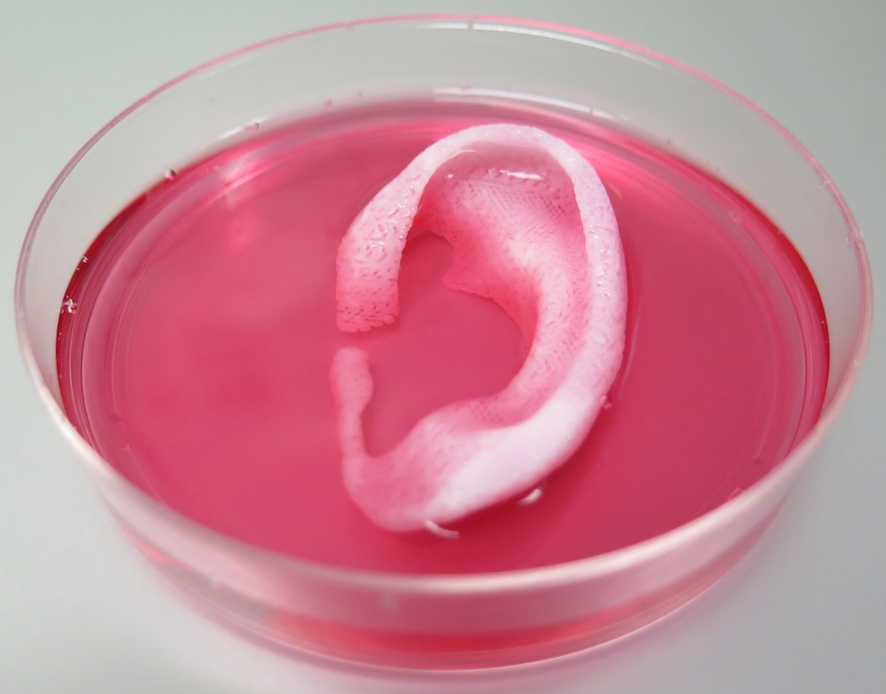
A 3D printed, human-size ear. Photo by the Wake Forest Institute for Regenerative Medicine
… That’s what I learned in school!
Refs.:
1: https://en.wikipedia.org/wiki/Paolo_Macchiarini
2: http://sverigesradio.se/sida/artikel.aspx?programid=83&artikel=6363136
Hoje, eu aprendi que:
Há muitos passatempos e hobbies interessantes no mundo, mas talvez o mais excitante de todos seria de viajar para todos os cantos do globo.
O Estado de S. Paulo mantém uma coluna semanal, intitulada “Mr. Miles”, em que o colunista conta acontecimentos das suas viagens e responde a dúvidas dos leitores. O texto em português é brilhante, salpicado com expressões tipicamente inglêses.
Hoje fomos informados que “MR. MILES É O HOMEM MAIS VIAJADO DO MUNDO. ELE ESTEVE EM 183 PAÍSES E 16 TERRITÓRIOS ULTRAMARINOS.”
Estadão normalmente publica verdades, mas essa afirmação não procede! Veja este recorte do jornal sueco Aftonbladet de 2010-10-07, que mostra o viajante profissional sueco, Peter Grip, que acabou de chegar no último dos 194 países independentes da época. Além disso, tinha visitado 40 territórios dos 130 existentes:
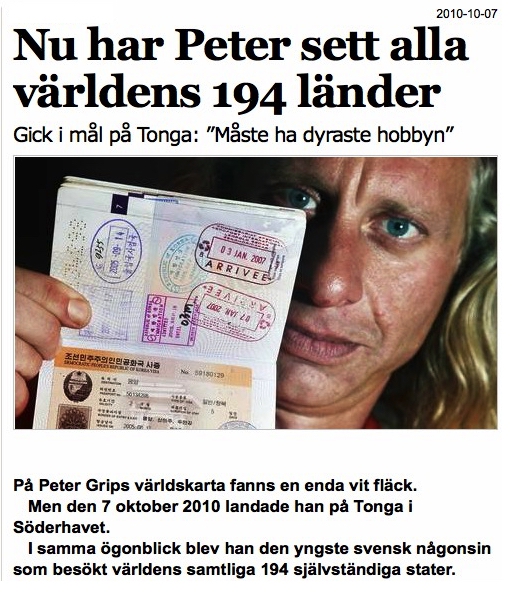
O homem mais viajado, Peter Grip, mostra o passaporte após ter chegado ao país 194 em 2010-10-07. Artigo no jornal sueco Aftonbladet.
… Por hoje é so!
(This article in Portuguese and Swedish presents the world’s greatest traveller.)
Refs.:
1: http://viagem.estadao.com.br/noticias/geral,comunicar-se-ou-nao-eis-a-questao,10000016090
Idag lärde jag mig, att:
Klubbmärket ovan har blivit utsett till världens vackraste klubbmärke. Det hände 1937 när den engelska firma som levererade tröjmärken till dåtidens största fotbollsklubbar ordnade en omröstning bland allmänheten i London om vilket av alla märken som de tillverkat var det vackraste. Majoriteten röstade då på Allmänna Idrottsklubbens (AIK) märke, detaljer finns i referens 1 nedan.
Och idag är det precis 125 år sedan AIK bildades, på Norrmalm i Stockholm. Antalet medlemmar, över 20.000, gör den till Nordens största idrottsklubb. Elva idrotter praktiseras av klubbens aktiva: Bandy, basketboll, boule, bowling, boxning, fotboll, friidrott, golf, handboll, innebandy och ishockey. Genom åren har det naturligtvis blivit tonvis av medaljer och mästerskap i dessa grenar, och även sådana som för närvarande inte är aktiva, såsom badminton, bordtennis, curling och tennis, samt naturligtvis sparkstöttning, som var en mycket populär sport på 1890-talet.
Födelsedagsfirandet kunde inte ha börjat bättre, herrlaget i fotboll slog 2015 års svenska mästare, IFK Norrköping, med 4-1 igår, och redan om två dagar kan det vara teoriskt klart att herrlaget i ishockey har chansen att kvala in till SHL efter två års förvisning till Allsvenskan. Så det är inte utan att en AIK-are såsom jag kan se framtiden an med optimism. Se också uppdatering gjord 2016-03-09 !
Till sist, men alls inte minst, grattis också till Annika på den gemensamma födelsedagen!
… Slut för idag, tack för idag!
(This post in Swedish celebrates the 125 years of foundation of the biggest sports club in the Nordic countries.)
Refs.:
1: Världens vackraste klubbmärke
2: AIK
Today, I learned once more that:
How good it is to have a quiet Sunday and just relax together with the family. And to open up the appetite for yet another tasteful lunch, nothing better than a refreshing drink. Although there are many wonderful drinks, gin and tonic being one of them, ever since the day I first set foot on Brazilian soil, I have been a fan of their national drink, called Caipirinha, as depicted in the following photo.
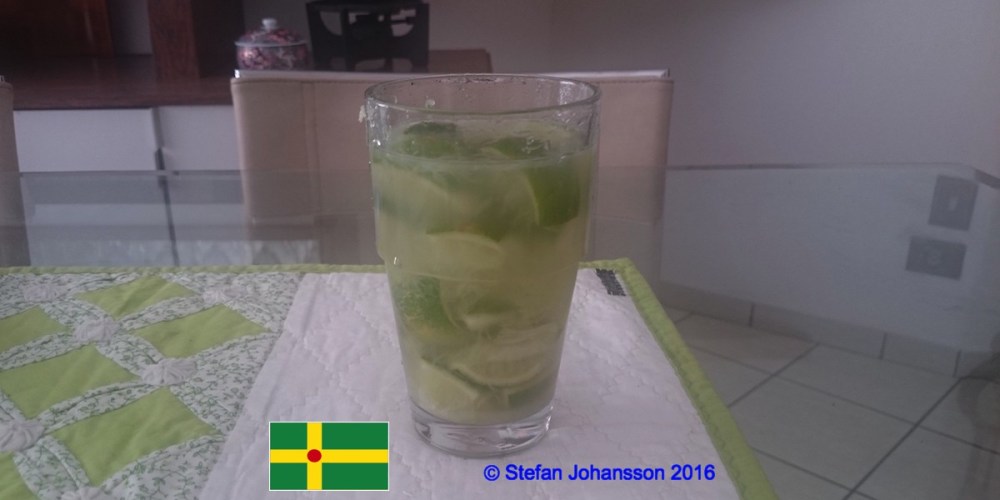
And if you have the right ingredients, there is nothing easier than making a Caiprinha. Here is the recipe:
Take one lime fruit and cut off the ends. Divide it into eight equal parts.
Put the parts in a tumbler glass.
Bring out the sugar, which must be made out of sugar cane to have the right sweetness. Depending on how sweet you like your drink, add the desired quantity of sugar. I normally use two soupspoons.
Using a wooden muddler, squeeze the juice out of the lime and let it blend with the sugar.
Add some cubes of ice on top.
Pour the sugar cane liquor, cachaça or pinga as it commonly known, over the solution.
Stir it very well, so that the liquor mixes well with the sweet solution.
Saúde !
But life is not only food and drinks. Although not my favourite pastime, I can very well understand those who look forward to when they can put their boat into the water and go for a trip. I recently came across a fantastic pulling boat, handmade only by wooden marine plank, no plastic! The marine planks were delivered by a Finnish company named Vendia, and currently they are exhibiting boats made of their planks at an international boat show in Helsinki, their capital. Look at the following photo, ain’t she a beauty:
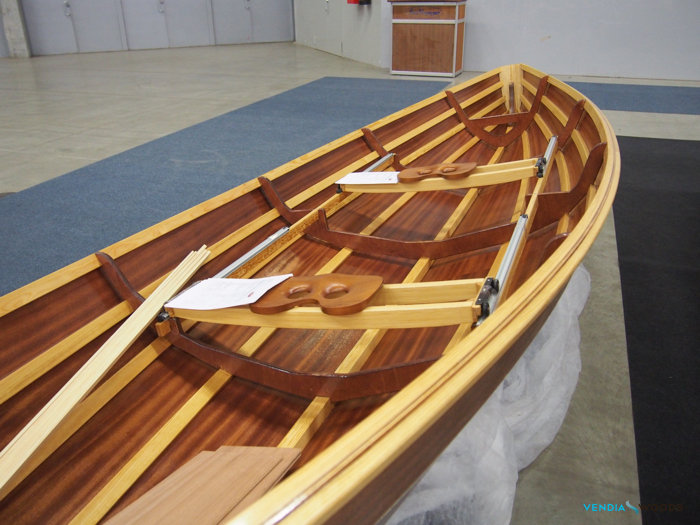
Pulling boat made of mahogany veneer marine plank. Photo by Vendia
… That’s what I learned in school!
Refs.:
1: Caipirinha
 What did you learn in School today?