157’2023 (2023-06-06) – 500 years !!!

Today, I learned about:

Our daily lives are not easy, there are always things to be done, money to be earned to maintain our lives and sustain our families. It is therefore such a pleasure for me to present the third part about my trilogy with tributes to some of the people and places that mean so much to me, besides my family, of course.

In my two earlier blogs, 113’2023 (2023-04-23) and 151’2023 (2023-05-31) , I presented tributes to some of my friends, and now I have the honor to express my gratitude to my native country, Sweden, where I was born, grew up, and started my professional career, before moving to Brazil.

The 500th anniversary of modern Sweden

You most certainly have heard about the vikings and their mythology. Sweden is one of the countries that was involved in such matters. When the vikings had their glory, Sweden was not a unified nation, there were many different reigns, but slowly during the first half of the 2nd millenium, there started a consolidation, not only of what eventually would be Sweden, but also of its neighbors, Denmark and Norway. A milestone occured in the year 1397, when the so called Kalmar Union was formed, led by Denmark and including also Sweden and Norway. But many Swedes had difficulty in accepting to be ruled by a non-Swede, so on June 6, 1523, Gustav Eriksson Vasa was elected King of Sweden, and from that day on we are entering the modern Swedish era. More about this can be found in reference #1 below.

Two days ago, considering that today is a normal work day in Brazil, the Swedish Consulate General in São Paulo celebrated thus the Swedish 500th anniversary with a fabulous party at the Scandinavian church in São Paulo. I had the pleasure of being invited and, between enjoying the traditional Swedish food and drink as well as meeting old friends, I was also able to take some nice pictures from the event.

The honorary consul, Renato Pacheco, held the opening speech, and after both the Swedish and Brazilian national anthems had been sung, it was time for the newly installed Swedish ambassador to Brazil, Karin Wallensteen, to give her version of why it is so important to know what happened 500 years ago and how it still reflects the daily life in Sweden.
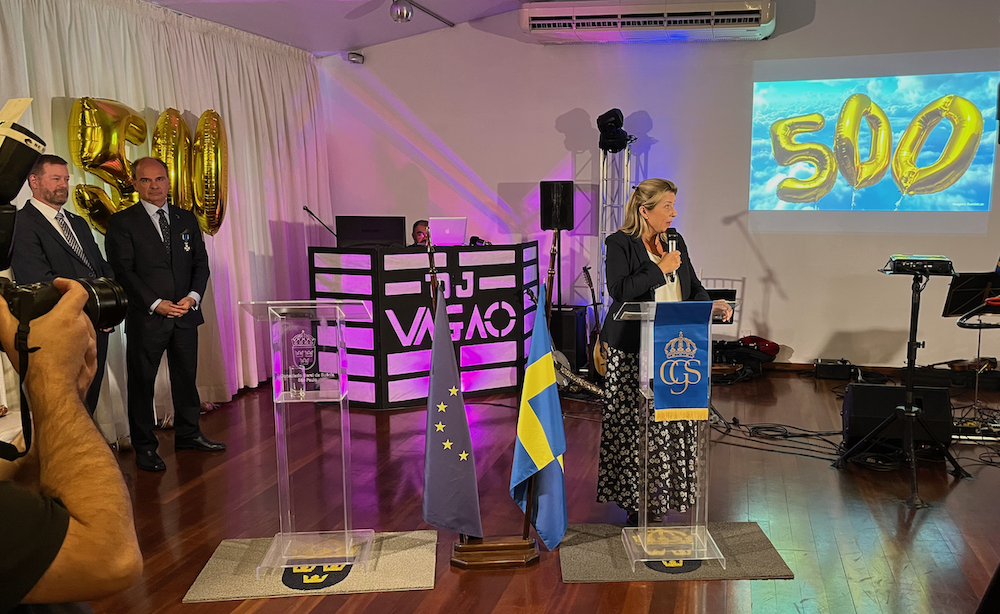
The Swedish embassador to Brazil, Karin Wallensteen, holds a speech of the importance of commemorating the modern Sweden’s 500th anniversary. In this picture can also be seen the vice-consul in São Paulo, Peter Johansson, and the consul, Renato Pacheco. Picture taken on 155’2023 (2023-06-04).

Svenska Danser

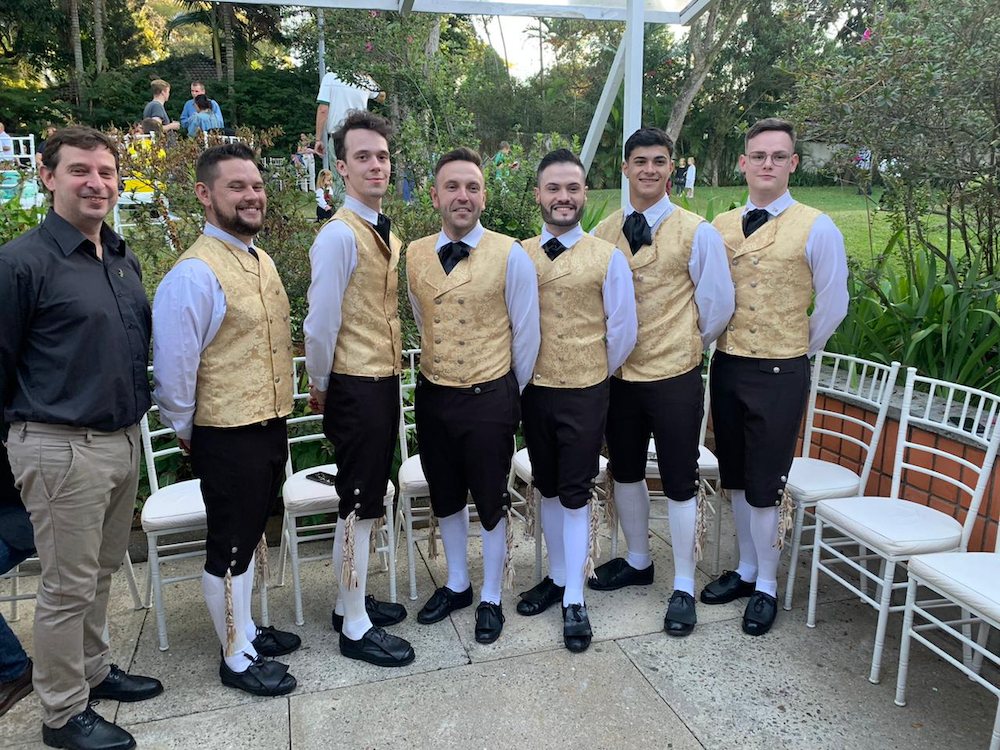
One very popular topic during the celebrations was the dance group Svenska Danser (Swedish Dances) from the very south of Brazil that performed traditional Swedish folk dances, like the one you can see in today’s header photo.

Reference #2 contains a link to an earlier live transmission with Svenska Danser, so you can see and hear them in action.
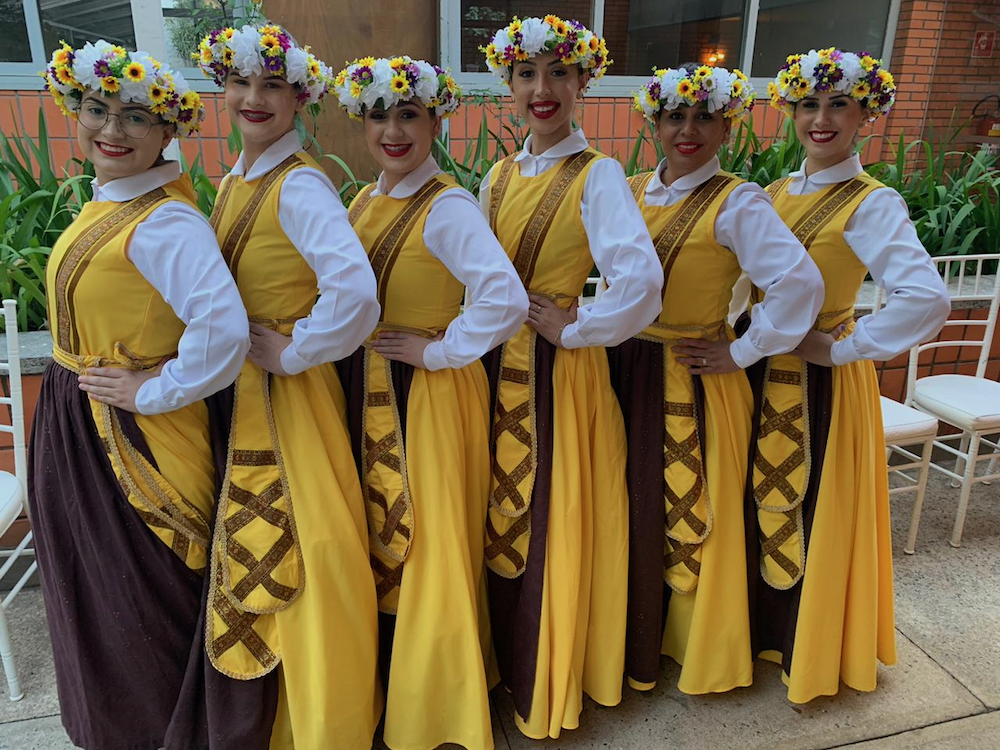
This lovely group of Brazilian women, dressed in Swedish traditional costume, is the female part of Svenska Danser (Swedish Dances), resident in Ijui, state of Rio Grande do Sul, Brazil, which demonstrated Swedish folk dances. Photo taken by Anders Pettersson.
And here are their male partners in Svenska Danser, who together the ladies performed the inspiring Swedish folk dances in today’s header photo. Photo taken by Anders Pettersson.

Clan Mac Norse

And there was also an equally popular musical event when the Nordic folk music group Clan Mac Norse presented their joyful music.

Reference #3 contains a link to an earlier live transmission with Clan Mac Norse, so you can see and hear them in action.
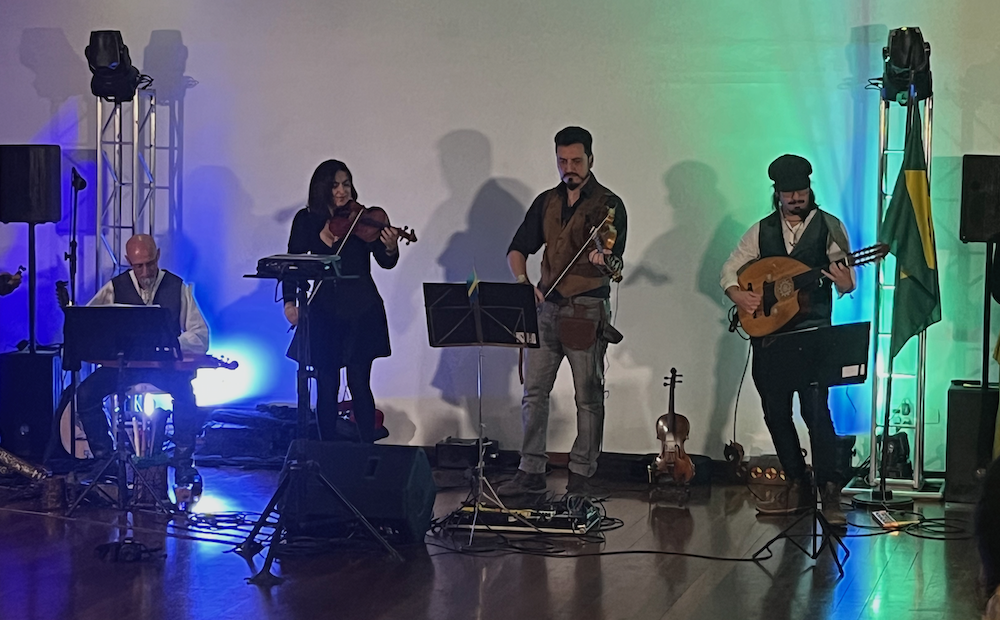
This music group is called Clan Mac Norse and their speciality is to play Nordic folk music. They come from Curitiba, state of Paraná, Brazil.

Göteborg 402 years

These days have also been extra festive in Göteborg (Gothenburg), Sweden’s second largest city, where the original 400th anniversary of the founding of the city in 2021 had to be postponed because of the Covid-19 pandemic.

But now it is was high time to celebrate. I studied at the Chalmers University of Technology in Göteborg and of course I would like to have been there in person to make my tribute to this lovely city. You may remember that in an earlier post, 59’2017 (2017-02-28) , Göteborg was elected by the British newspaper The Guardian to be the number one city in the world regarding the social behaviour and attitudes of its residents.

Finally, look at the way FIESP, the mighty industry organization in the state of São Paulo, gave Sweden, with so many companies installed in the state, its tribute tonight:

FIESP in yellow and blue!

That’s what I learned in school today!

Ref.:
1: Kingdom of Sweden

2: Svenska Danser

3: Clan Mac Norse

*: What did you learn in school today ?

120’2022 (2022-04-30) – Sköna maj välkommen, mer än någonsin på mycket länge!

Today, I learned about:

In my earlier post of 122’2020 (2020-05-01), I talked about the importance of this day in Sweden. It is then that the Swedes celebrate the arrival of Spring in many festive ways. But due to the COVID-19 pandemic, it has now been three years since that could be done in the traditional way. I am therefore very happy that today represents going back to the traditions, and as an alumni of Chalmers University of Technology, the most important thing is of course the parade of trucks disguised as settings for various events during the preceding year, the so-called Cortege.

In my earlier post of 365’2019 (2019-12-31), I also mentioned the result of a scientific activity on Chalmers that looked utterly interesting, how to capture and store solar energy up to 18 years. Now I am pleased to show you the developments after that. As you can see in reference #1 below, Chalmers together with mainly researchers at Shanghai Jiao Tong University, China, are now proceding with a system that does all that.

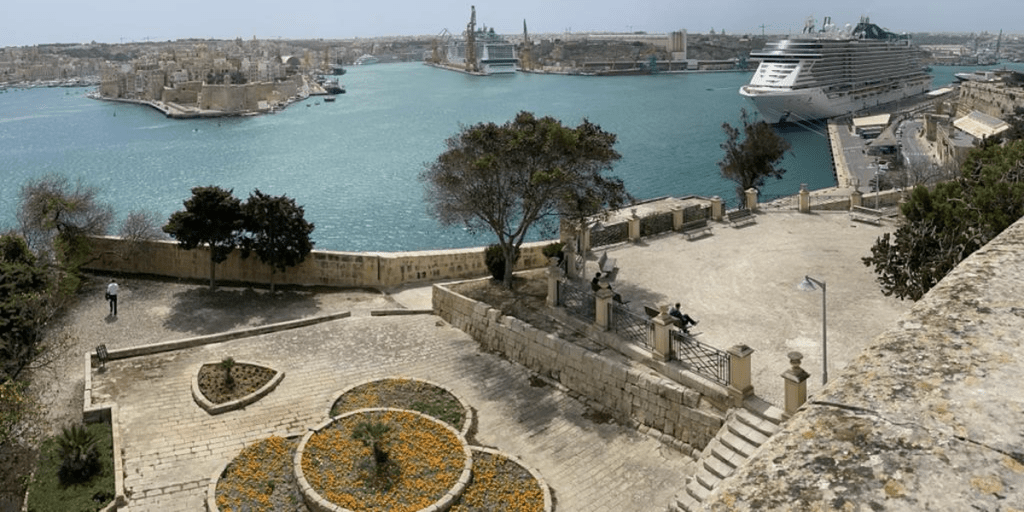
Today’s header photo, sent to me by my good old friend Dina Giltinan, shows the Grand Harbour in Valletta, Malta. Thank you, Dina, for yet another contribution to my blog ! (I earlier showed another photo from Malta in my blog of 247’2016 (2016-09-03).

A view of Tthe Grand harbour of Valletta, the capital of Malta. Photo taken by Dina Giltinan on 110’22 (2022-04-20).

That’s what I learned in school today!

Ref.:

1: Converting solar energy to electricity on demand

*: What did you learn in school today ?

2020-05-01 (Sköna maj välkommen!)

Today, I learned about:

Nothing is like it used to be. Yesterday was April 30, the day that Sweden is used to celebrate the arrival of Spring with various fun events during Valborgsmässoafton (Walpurgis night). The whole story started already during the 8th and 9th century in England. You can read more about it in reference #1 below.

One popular tradition on that day in Gothenburg, Sweden’s second biggest city, is the Cortège, when the first-years students at Chalmers University of Technology give their review of the events of the preceding year in a carnival-style parade. The following photo was taken during the Cortège in 1977. I had the pleasure of participating in it two years earlier and I must admit it was really a treat.

Picture from the Chalmers Cortège 1977, showing a joke about the pop group Abba. Photo taken on 1977-04-30 by Pål-Nils Nilsson, from the archives of Riksantikvarieämbetet (Swedish National Heritage Board) .

Another tradition on that day is to light bonfires as a way to keep the evil spirits away, and especially in the old university cities of Uppsala and Lund people gather to hear the students choirs sing their traditional songs praising Spring.

But, nothing of that sort happened yesterday. The COVID-19 pandemic impeded all those traditions to be celebrated once more. It was therefore a pleasant surprise what Radio Sweden had in store for us.

The classical music channel P2 had invited its listeners to contribute in a special way, by recording their voices and faces when singing the traditional song Längtan till landet (I am longing for the countryside). See reference 2 below for the P2 page and reference 3 for the video with the song.

And if you want to sing along with all the other 707 singers in the choir, here are the lyrics:

I dedicate this post to my dear old friend Bosse, who took so well care of me from the moment I first arrived in Brazil. He loves this kind of music, his idol is the late Jussi Björling, need I say more? For those who do not recognise that name, let us compare him to later day tenors like Luciano Pavarotti, Plácido Domingo, and José Carreras. See also reference 4 below.

That’s what I learned in school !

Ref.:

1: Walpurgis Night

2: Hela Sverige sjunger in våren!

3: Hela Sverige sjunger i P2:s valborgskör

4: Jussi Björling

*: What did you learn in school today ?

2019-12-31 (Réveillon!)

Today, I learned about:

Once again, it is that day of the year when we reflect over how the year behind us was and make our predictions and wishes for the year to come.

One important piece of news during 2019 was that researchers at my alma mater Chalmers University of Technology, Gothenburg, Sweden, led by professor Kasper Moth-Poulsen reported that they have developed a molecule, that is able to capture the sun’s rays, store it as chemical energy for up to 18 years, and retrieve the energy and convert it into heat when needed.

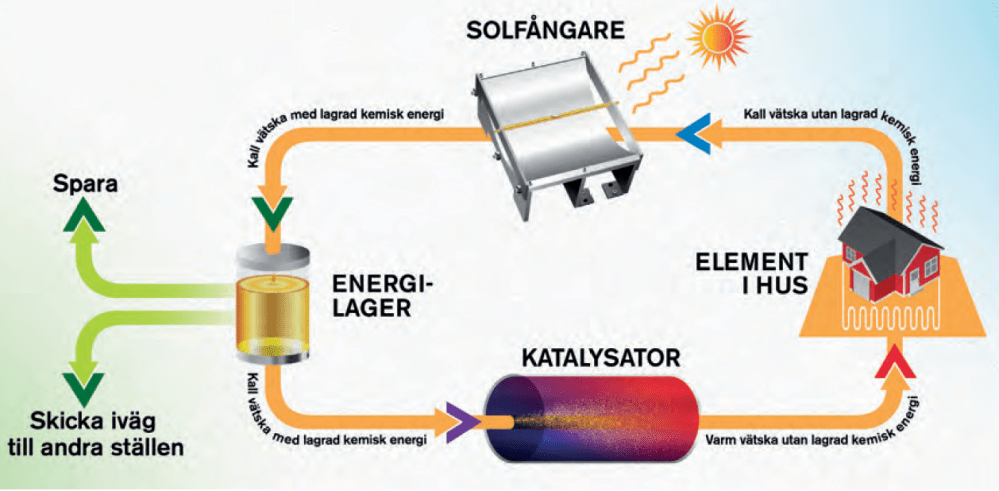
The following graphic shows how it all works:

It all starts in the upper middle section of the sketch. The solar reflector (SOLFÅNGARE) placed on the roof of a building captures the sun’s rays. The parabolic section concentrates solar energy and transmits it to the liquid in the tube in the center of the solar reflector. From there, the cold liquid, now containing stored chemical energy, is sent to an energy storage (ENERGILAGER). It can be stored there for up to 18 years! When we need to heat up our house, we simply let some of the liquid out from storage, run it through the catalyst (KATALYSATOR), thus obtaining a hot liquid without any stored chemical energy. Experiments have shown that the liquid with released heat can have a temperature that is 63 °C higher after the catalyst in relation to before! The hot liquid then goes into the normal heating system of the house, e.g. the radiators (ELEMENT I HUS) in the various rooms, heats up the ambient, and then the now cold liquid goes back up to the roof to capture more sun rays. Graphic made by Yen Strandqvist.
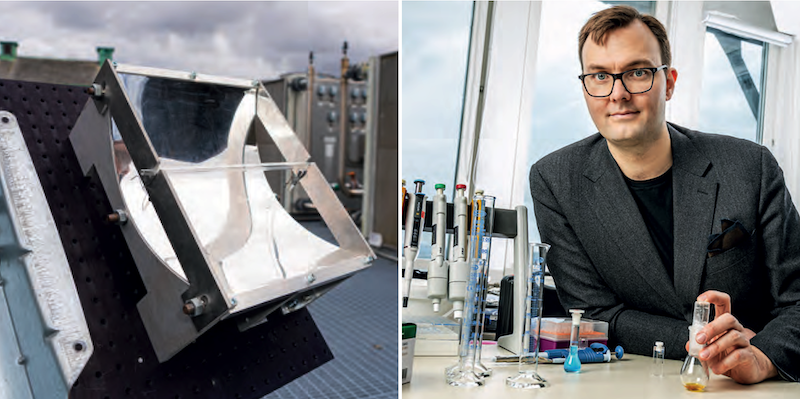
The leftmost photo shows the parabolic solar reflector with the liquid tube in the center. To the right is the inventor of the material, professor Kasper Moth-Poulsen, securing a small sample of the miraculous liquid. All material has been extracted from Chalmers Magasin no. 1 2019, text by Karin Aase and photos taken by Oscar Mattsson and Johan Bodell.

References # 1 through 4 below contain more material if you are interested in further details.

Can you use an hourglass?

According to Wikipedia: “An hourglass (or sandglass, sand timer, sand clock or egg timer) is a device used to measure the passage of time. It comprises two glass bulbs connected vertically by a narrow neck that allows a regulated flow of a substance (historically sand) from the upper bulb to the lower one. Typically the upper and lower bulbs are symmetric so that the hourglass will measure the same duration regardless of orientation. The specific duration of time a given hourglass measures is determined by factors including the quantity and coarseness of the particulate matter, the bulb size, and the neck width.

So you think are smart? Then show it now! We have two hourglasses like the ones shown above. The bigger ones completes one cycle in 11 minutes, the small one in 7 minutes.

Question: Using a combination of these two hourglasses, you need to measure a time lapse of exactly 15 minutes. How would you do it? (Solution to follow in the first blog post of 2020.)

I wish all my faithful blog readers a HAPPY NEW YEAR!

That’s what I learned in school !

Refs.:

1: Extract from Chalmers Magasin nr 1 2019 (article in Swedish)

2: An energy breakthrough could store solar power for decades

3: Storing the energy from the sun for decades

4: Liquid sunlight creates heat on demand

*: What did you learn in school today ?

2016-05-22 (Sunday)

Today, I learned that:

The Brazilian-Swedish seminar I attended earlier this week, see my post of 2016-05-18 , was in fact the fifth of the same type that SACF (Swedish Academic Collaboration Forum) arranged. Earlier, it had been hosted in Korea, Singapore, China, and Indonesia, all with the aim to promote the exchange of ideas and opinions in academic matters and scientific research. In February, 2017, there is planned another event, where the participating countries of these five seminars will gather in Stockholm, Sweden, for a follow-up.

Today, I will concentrate on the seminar in Brazil and hope to be able to comment on the earlier four on a later occasion. The two days in Brasília were packed with interesting presentations and networking opportunities. And the earlier weeks of commotion in the federal capital could not be seen here, on the contrary. There were many positive and inspiring comments on what happens when Brazilians and Swedes join forces in advancing the frontiers of science.

Basically, there were four kinds of seminars in one:

  • Top level management sessions, where the most prominent representatives from the Brazilian and Swedish universities discussed “Internationalisation and Collaboration in Higher Education”, “Funding for promoting world class research collaboration”, and “Brazil-Sweden: Importance of University & Industry collaboration”.
  • 5 different series of academic sessions, namely “Imaging and Visualization in Life Science”, “Novel Functional Materials and Nanotechnology” (2 parallel sessions due to the number of topics presented),”Inclusive Education: Gender & Ethnicity”, “Sustainable Development: Energy, Environment and Biodiversity”, and “Machine Intelligence and Autonomy” (also 2 parallel sessions due to the number of topics presented).
  • A funding seminar, where funding agencies and universities interchanged ideas and suggestions about various aspects of funding of scientific research.
  • An innovation seminar, where the Swedish innovation agency Vinnova presented programs for funding and gave various examples of successful Swedish-Brazilian projects.

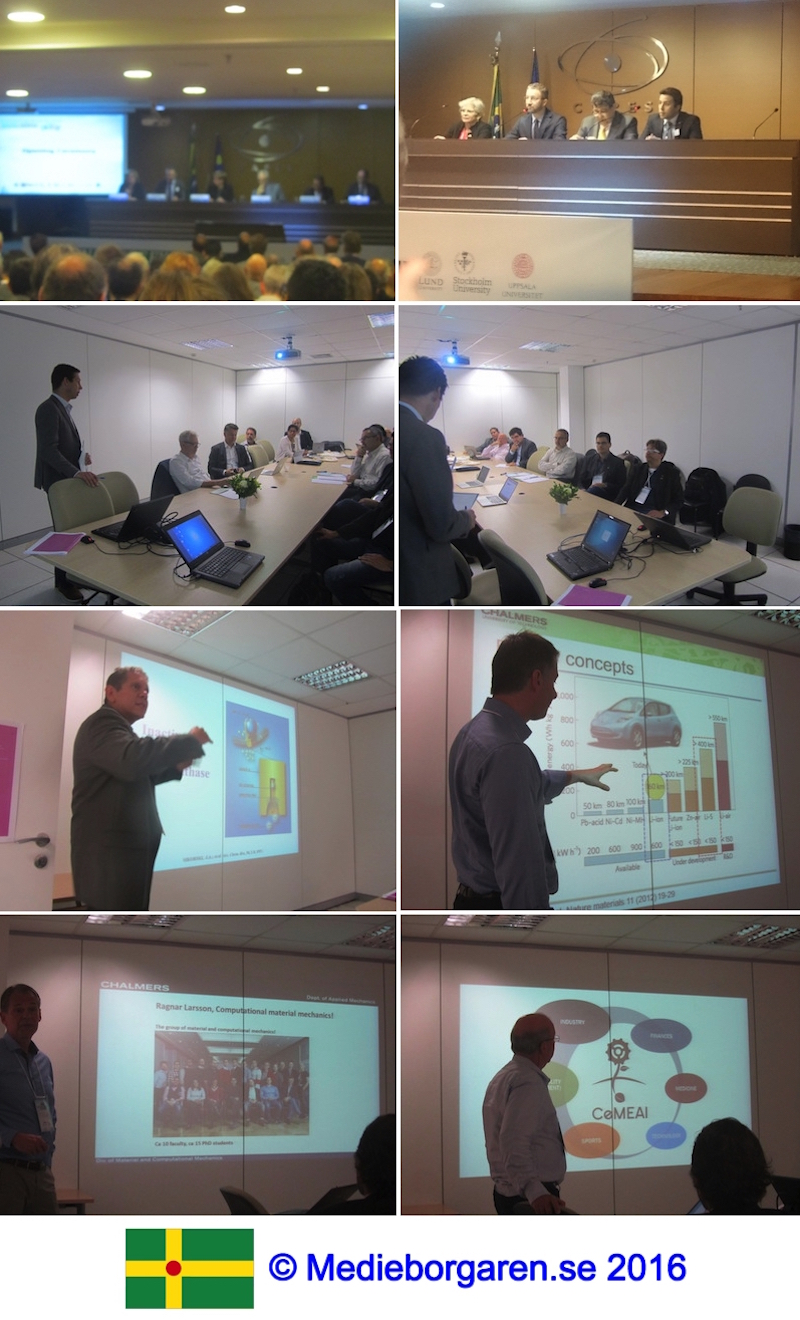
I decided to dedicate my time of the academic sessions to learn more about new materials and nanotechnology, to follow up the knowledge I had acquired through the MOOC about graphene in 2015, see also my post of 2016-02-01. Below are some pictures I took of the event.

I wish to extend my sincere gratitude for inviting me, to the organizers of this extra ordinary seminar with so many brilliant minds gathered in one place, Gustaf Cars (Uppsala University), Helena Balogh (Linköping University), and Åsa Valadi (Chalmers University of Technology)!

CAPES

Update 2016-05-29:

On the web site of CAPES, there is further information, with photos, of the two days of seminar. Please consult references #2 and 3 below.

Finally, I just learned that the mysterious first chord of the Beatles song from 1964,”A hard day’s night”, in fact are three different chords, played by George Harrison, John Lennon and Paul McCartney, joined into one. That is what I call a perfect cooperation project! Reference #1 below, in Portuguese, presents all the facts behind this Magical Mystery Chord, with images and video clips.

… That’s what I learned in school !

Refs.:

1: Um acorde mágico dos Beatles revelado depois de 52 anos de mistério

2: Capes recebe Seminário de Excelência Brasil-Suécia

3: Brasil e Suécia pretendem intensificar cooperação científica entre os dois países

+: What did you learn in school today ?